
Amazon FBA Fulfillment Centers: 1,000+ Same-Day Sites by 2031
Amazon plans to expand from 85 to over 1,000 same-day fulfillment centers across the U.S. by 2031 under Project Mercury, fundamentally reshaping FBA logistics and seller strategy.
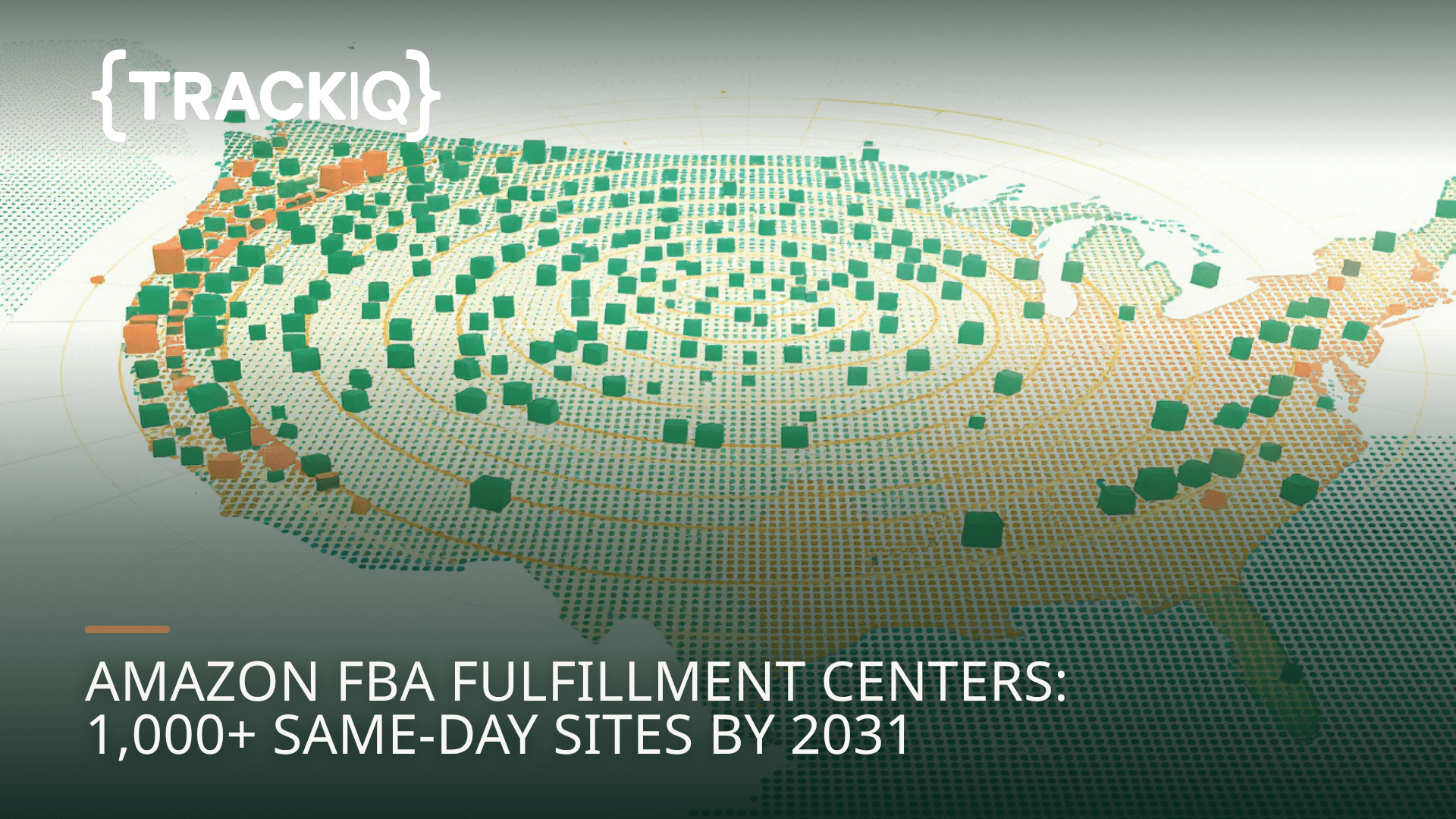
Amazon is planning to build over 1,000 same-day fulfillment centers across the United States by 2031 under an initiative called Project Mercury, up from approximately 85 facilities today. This expansion will position fulfillment infrastructure within 10 miles of 80% of the U.S. population, dramatically accelerating delivery speeds and reshaping inventory placement strategies for FBA sellers.
Key Takeaways: Amazon's Fulfillment Infrastructure Overhaul
Massive expansion: Amazon plans to grow from 85 to 1,000+ same-day fulfillment centers by 2031 under Project Mercury
Proximity strategy: Facilities will be within 10 miles of 80% of the U.S. population, fundamentally changing delivery economics
Seller impact: FBA inventory placement, inbound shipping strategies, and competitive positioning will require significant adaptation
Delivery speed advantage: Same-day and next-day delivery will become the default expectation rather than a premium service
Regional inventory distribution: Sellers will need to think hyperlocal about inventory allocation across hundreds of micro-fulfillment nodes
What Amazon's Project Mercury Means for FBA Sellers
Amazon is undertaking the largest fulfillment infrastructure buildout in its history. The company plans to expand its network of same-day Amazon FBA fulfillment centers from approximately 85 facilities today to more than 1,000 by 2031 under an initiative internally called Project Mercury.
[[TQ_YOUTUBE:-pdkayNDkqw]]
This represents a roughly 12-fold increase in same-day infrastructure over five years. The strategic goal is clear: position fulfillment capacity within 10 miles of 80% of the American population.
This proximity threshold enables economically viable same-day delivery at scale, transforming what has been a premium logistical capability into standard operating procedure. For the estimated 2+ million active FBA sellers, this shift will require fundamental changes to how inventory is sourced, allocated, and managed across Amazon's network.
According to industry analysis, this expansion represents Amazon's response to heightened delivery expectations and increasing competition from retailers like Walmart and Target who have invested heavily in their own hyperlocal fulfillment networks.
The Current State of Amazon FBA Fulfillment Centers
Today's fulfillment infrastructure is built around regional distribution. Amazon currently operates a multi-tiered network that includes large regional fulfillment centers (500,000+ square feet), sortation centers, delivery stations, and approximately 85 same-day facilities concentrated in major metropolitan areas.
The existing model works on hub-and-spoke logistics: products are stored in large regional warehouses, then distributed through intermediate sortation and delivery nodes. Same-day delivery is currently available only in select urban markets and typically requires products to be stocked at one of those 85 specialized facilities.
85 same-day facilities currently serve approximately 100 million U.S. customers with same-day delivery options as of early 2026.
FBA sellers today have limited control over placement. Amazon's Inventory Placement Service allows sellers to send inventory to a single fulfillment center (for a fee) or distribute across multiple locations using Amazon's algorithms.
The system optimizes for Amazon's overall network efficiency, not necessarily for individual seller delivery speeds or costs.
Project Mercury: A Hyperlocal Fulfillment Revolution
The 10-mile proximity target is the critical metric. By positioning over 1,000 micro-fulfillment centers within 10 miles of 80% of the population, Amazon can complete last-mile delivery in 2-4 hours using existing delivery service partner networks without requiring premium air freight or expedited ground transportation.
[[TQ_IMG:https://framerusercontent.com/images/ep0W1uCFcTssXxOo1njNQ6bV6Y.png|The Current State of Amazon FBA Fulfillment Centers]]
This geographic density fundamentally changes the economics of fast delivery. Currently, same-day delivery requires either maintaining inventory in expensive urban warehouse space or paying for expedited shipping from regional hubs.
With 1,000+ facilities, same-day becomes the default because products are simply closer to customers.
Why 10 Miles Matters
The 10-mile radius enables predictable delivery windows. A delivery driver can complete multiple stops within a 10-mile radius in a 2-3 hour route, making the economics of same-day delivery comparable to traditional next-day service.
Beyond 20 miles, route density decreases and per-package costs rise exponentially.
Urban and suburban density drives the model. The strategy focuses on population density rather than geographic coverage. Serving 80% of the population requires covering perhaps only 15-20% of U.S. land area, concentrating infrastructure in metropolitan statistical areas and surrounding suburbs where order volumes justify facility investment.
How This Changes FBA Strategy for Sellers
Inventory allocation becomes exponentially more complex. Instead of managing stock across 10-15 regional facilities, sellers may need to think about distribution across hundreds of micro-fulfillment nodes.
While Amazon's algorithms handle physical placement, sellers must ensure adequate inventory depth to support this distributed model without stockouts.
Winners and Losers in the New Model
Seller Profile | Likely Impact | Strategic Adaptation |
|---|---|---|
High-volume, fast-moving SKUs | Major advantage | Qualify for same-day placement, improved conversion, reduced long-haul costs |
Low-volume, slow-moving items | Challenging | May be excluded from hyperlocal facilities, remain in regional centers with slower delivery |
Seasonal products | Mixed | Need sophisticated demand forecasting to justify distributed placement during peak |
Oversized/heavy items | Limited benefit | Economics don't support same-day for bulky goods; remain in specialized facilities |
Replenishment velocity becomes critical. With inventory spread across 1,000+ locations, stockouts at individual facilities become more frequent unless sellers maintain higher overall inventory levels or implement more responsive replenishment systems.
This may increase working capital requirements for sellers who want to maintain same-day eligibility across markets.
Inbound Shipping Economics Shift
Transportation costs to Amazon may decrease for some sellers. With more facilities distributed geographically, the average distance from manufacturer or 3PL to Amazon FBA fulfillment centers should decrease.
This could reduce inbound shipping costs, particularly for sellers using less-than-truckload (LTL) or parcel shipments.
However, distributed fulfillment may require more frequent, smaller shipments. If Amazon's algorithms place inventory across dozens of facilities instead of a handful, sellers may lose the efficiency of consolidated large shipments. This trade-off between inbound shipping efficiency and outbound delivery speed will vary by product category and sales velocity.
Competitive Implications: The Delivery Speed Arms Race
Same-day delivery becomes table stakes, not a differentiator. Today, offering same-day delivery is a competitive advantage that improves conversion rates by 15-30% for eligible products.
When 1,000+ facilities make same-day the default experience, sellers without same-day eligibility will face the conversion disadvantage.
Same-day delivery currently increases conversion by 20-30% for eligible products in urban markets where it's available, according to e-commerce research.
Small and medium-sized sellers face pressure. High-volume sellers with fast-moving inventory will naturally populate same-day facilities because Amazon's algorithms prioritize products that justify the space.
Smaller sellers with lower velocity may find their products relegated to regional centers, creating a delivery speed disadvantage that compounds over time as consumer expectations shift.
The Amazon Prime Expectation Reset
Two-day delivery will feel slow by 2031. As same-day becomes widely available, consumer expectations will recalibrate. Products that arrive in two days—once the gold standard of Prime—may be perceived as slower-moving inventory or lower-priority items.
This psychological shift could affect conversion rates and product reviews ("arrived quickly" becomes relative to same-day benchmarks).
Product discovery may favor faster-delivery items. Amazon's search and recommendation algorithms already factor delivery speed into ranking and visibility. With hyperlocal fulfillment, products available for same-day delivery in a customer's area may receive preferential placement in search results and buy box allocation.
This creates a virtuous cycle where faster delivery drives more sales, which justifies continued same-day placement.
The Data Challenge: Managing Inventory Across 1,000+ Nodes
Sellers need real-time visibility into distributed inventory. Managing stock levels across dozens or hundreds of facilities requires sophisticated analytics and forecasting.
[[TQ_IMG:https://framerusercontent.com/images/LUZsGWGlUEHl4gIILutM7pNqk.png|How This Changes FBA Strategy for Sellers]]
Sellers using tools like TrackIQ that connect AI assistants directly to live Amazon data will have a significant advantage in monitoring inventory health, identifying stockout risks, and optimizing replenishment across this distributed network.
Regional demand patterns become more important. With inventory positioned hyperlocally, understanding regional demand variations—seasonal differences, local events, demographic preferences—becomes critical for efficient allocation.
National-level demand forecasting isn't sufficient when inventory decisions happen at a city-by-city or even neighborhood-by-neighborhood level.
Automated Inventory Decision-Making
Manual management becomes impossible at scale. A seller managing 20 SKUs across 200 facilities faces 4,000 distinct inventory positions to monitor. This requires automated systems that can predict demand, trigger replenishment, and rebalance inventory across locations without constant human intervention.
This is where AI-powered business intelligence becomes essential. Systems that can analyze sales velocity by region, predict seasonal patterns, and automatically recommend inventory actions will separate successful sellers from those overwhelmed by operational complexity.
Implementation Timeline and What to Watch
The rollout will be gradual through 2031. Amazon will likely prioritize the largest metropolitan areas first—New York, Los Angeles, Chicago, Dallas, Houston—before expanding to mid-sized cities and suburban markets.
Sellers should monitor which markets receive new facilities and adjust their inventory strategies accordingly.
Key Milestones for FBA Sellers
2026-2027: Expect 50-100 new same-day facilities annually in top 30 metros; test inventory allocation strategies in newly served markets
2028-2029: Accelerated buildout (150-200 facilities/year); Amazon may introduce new placement fees or incentives to populate hyperlocal inventory
2030-2031: Final push to 1,000+ facilities; same-day becomes default expectation; sellers without same-day eligibility face significant conversion disadvantage
Fee structures will likely evolve. Amazon may adjust FBA fees to reflect the new economics of hyperlocal fulfillment. This could include differential pricing for same-day-eligible inventory, changes to inbound placement fees, or storage cost variations between facility types.
Sellers should budget for potential fee adjustments as the network expands.
Preparing Your FBA Business for Hyperlocal Fulfillment
Start optimizing for velocity now. Products with consistent, high-velocity sales will naturally qualify for distributed placement in same-day facilities.
Focus on identifying your fastest-moving SKUs and ensuring they have adequate inventory depth to support multi-location distribution without proportionally increasing total inventory investment.
Improve demand forecasting capabilities. Regional demand patterns will matter more than ever. Invest in analytics that can identify geographic demand variations and seasonal patterns at the market level, not just nationally.
This will help you position inventory where it's needed before Amazon's algorithms do it for you (or exclude you from optimal placement).
Actionable Steps for 2026
Audit your current fulfillment speed profile: Identify which of your products are currently same-day eligible and in which markets; this is your baseline for measuring expansion impact
Analyze sales by metropolitan area: Understand where your customers are concentrated geographically to predict which new facilities will benefit your business most
Stress-test inventory levels: Model how your current inventory practices would work if distributed across 3x or 5x more facilities; identify working capital and replenishment gaps
Evaluate 3PL and manufacturing relationships: Ensure your supply chain can support more frequent, geographically distributed shipments to Amazon
Sellers should plan for 30-50% higher distributed inventory levels to maintain the same stockout rates when inventory is spread across 5-10x more facility locations.
The Broader Competitive Context
Amazon isn't alone in this race. Walmart has built out 4,000+ stores that double as micro-fulfillment centers, offering same-day delivery and pickup from locations already embedded in communities.
Target has similarly invested in store-based fulfillment. Amazon's Project Mercury is catching up to the physical retail advantage of having stores within miles of most customers.
The hyperlocal trend extends beyond Amazon. For sellers using multi-channel fulfillment, the rise of distributed infrastructure across all major platforms means delivery speed becomes a universal competitive factor.
Sellers who can't support fast fulfillment across channels may find themselves at a structural disadvantage regardless of platform.
Long-Term Strategic Questions
Will Amazon introduce tiered FBA programs? It's plausible that Amazon could create distinct FBA service levels—standard regional fulfillment versus premium same-day eligibility—with different fee structures and performance requirements.
Sellers should be prepared for more complex program options as infrastructure differentiates.
How will this affect international sellers? Sellers shipping from overseas may face longer lead times to replenish distributed inventory across 1,000+ locations. This could advantage domestic manufacturers and 3PLs who can respond more quickly to regional stockouts, potentially reshaping sourcing strategies for import-dependent sellers.
What happens to rural and low-density markets? The 80% population coverage target explicitly excludes 20% of Americans, primarily in rural areas. This could create a two-tier marketplace where delivery speeds and customer expectations vary significantly by geography, affecting which products and sellers succeed in different markets.
Final Thoughts: Adaptation Is Mandatory
Project Mercury represents a fundamental reset of Amazon FBA fulfillment centers and the economics of e-commerce logistics. The shift from regional distribution to hyperlocal fulfillment will reward sellers who can manage complexity, maintain inventory velocity, and leverage data for distributed decision-making.
For businesses using modern AI-powered analytics platforms like TrackIQ to monitor performance across Amazon's evolving network, this expansion creates opportunities to optimize inventory placement, reduce costs, and maintain competitive delivery speeds as the marketplace transforms around them.
[[TQ_SOURCES]]Amazon's Reported 1,000 Warehouse Plan Could Reshape FBA - EcomCrew | https://www.ecomcrew.com/amazons-reported-1000-warehouse-plan-could-reshape-fba/; Amazon Fulfillment by Amazon (FBA) | https://sellercentral.amazon.com; Amazon Operations & Innovation | https://www.amazon.com; Amazon Advertising | https://advertising.amazon.com

Jacob Heinz
Frequently asked questions
How many same-day fulfillment centers does Amazon currently operate?
Amazon currently operates approximately 85 same-day fulfillment centers in the United States as of 2026. Project Mercury aims to expand this network to over 1,000 facilities by 2031.
What is Amazon Project Mercury?
Project Mercury is Amazon's initiative to build 1,000+ same-day fulfillment centers by 2031, positioning facilities within 10 miles of 80% of the U.S. population to enable faster delivery and improved inventory distribution.
How will Project Mercury affect FBA sellers?
Project Mercury will require FBA sellers to optimize inventory placement across more distributed facilities, may reduce long-haul shipping costs, enable faster delivery speeds that improve conversion rates, and potentially create more competitive pressure on delivery promises.
Will Amazon charge sellers differently for same-day fulfillment?
Amazon has not announced specific fee changes related to Project Mercury. However, expanded same-day infrastructure may influence FBA fee structures, particularly around placement service fees and inbound shipping costs as inventory gets distributed closer to end customers.
What products benefit most from same-day fulfillment centers?
High-velocity items with consistent demand, consumables, impulse purchases, last-minute needs (gifts, emergency replacements), and lightweight products benefit most from same-day fulfillment due to improved conversion rates and reduced stockout windows.
─ READY WHEN YOU ARE
Ready to plug TrackIQ into your AI?
Install in under five minutes. No credit card. Bring your own Claude, ChatGPT, or Cursor — TrackIQ handles the data.